Guides · Activation
Why your SaaS trials don't convert, and how to find the step where they stop
A trial that doesn't convert usually ended long before its last day. How to split your trials by what people did, find the step that separates the ones who pay, and what to change first.
When a trial ends without a payment, it's tempting to blame the last day: the price, the reminder that didn't go out, the card form. Usually the trial was lost in its first two days, when the person never got to the moment the product was useful.
This guide is how to find that moment for your product, and the step where trials go wrong before it.
Split your trials by what people did
The trial-to-paid rate on its own tells you almost nothing. Split it by whether people activated, the moment they got what they came for:
| Trials started in the last 60 days | People | Paid |
|---|---|---|
| Activated during the trial | 38 | 17 (45%) |
| Never activated | 52 | 2 (4%) |
An example, not real data. This shape is the common one: the people who activate convert many times more often than the ones who don't. If yours looks like this, your conversion problem is an activation problem, and the price is a distraction.
If both rows convert about the same, it really is about price, value or the moment you ask, and the rest of this guide matters less than your pricing page.
Find the step that separates the ones who pay
Take the people who paid and the ones who didn't, and compare what each group did in their first days:
- The steps they reached. Write your onboarding as three to five steps and count each group at each one. The step where the two groups split is the one to fix. How to measure it
- How fast. Paying users often reach value on day one. If the ones who don't pay take three days to reach the same step, speed is the problem.
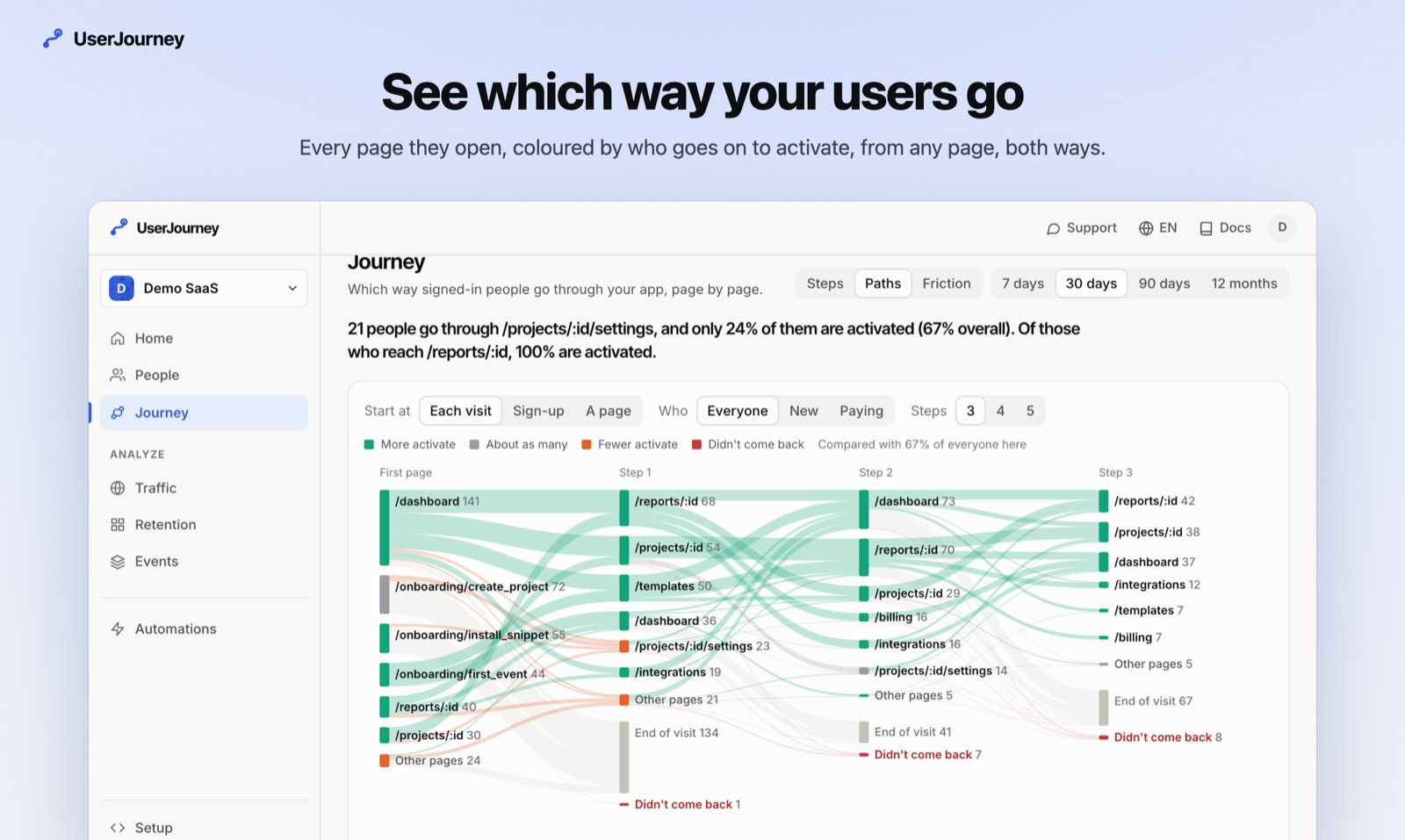
- Where they went. The pages people open right after signing up tell you what they expected to find. Reading paths
The four usual culprits
- The first step asks too much. Connect a data source, invite the team, configure a domain. Offer sample data or a default so they see value before they do the work.
- Value needs someone else. If the product only works once a developer installs something, the person who signed up waits, and the trial runs out. Give them something to send that developer, or a way to try it without them.
- The trial is too short for how you're used. A weekly-report product can't prove itself in seven days. Match the trial to one full cycle of use.
- Nobody noticed they were stuck. A person who stopped at step two on day one, and heard nothing until "your trial ends tomorrow", was lost a week ago.
Write at the right moment
Three notes do most of the work, each one short and from your name:
- When someone is stuck, a day after they stopped making progress: name the step, link straight to it, ask what got in the way.
- When someone activates, a short "you're set up" with the one thing worth doing next.
- Before the trial ends, a few days ahead, not the morning of: what they've built, what happens to it, and how to keep it.
The first one matters most, and it's the one most products never send.
Doing it with UserJourney
Trials come from Stripe or Paddle by themselves, on each person. Funnel shows every step from the sign-up to paying, with the biggest drop in a sentence and how long each step takes. Paths shows where people go after signing up, coloured by who activates. Today lists whose trial ends soon and who is stuck right now, with a note already written for the step they stopped at, and the playbooks can send the stuck and trial-ending notes for you.
Start for free or read the quickstart.
More guides
How to find where users drop off in your SaaS onboarding
Where new sign-ups stop before they get any value: how to write your onboarding as steps, measure each one, tell a drop-off from a slow start, and what to fix first.
4 min readActivationHow to see the paths users take through your SaaS app
A funnel tells you where people drop. Paths tell you where they went instead. How to build user flows that are readable, avoid the usual traps, and find the pages that lead to activation.
3 min read